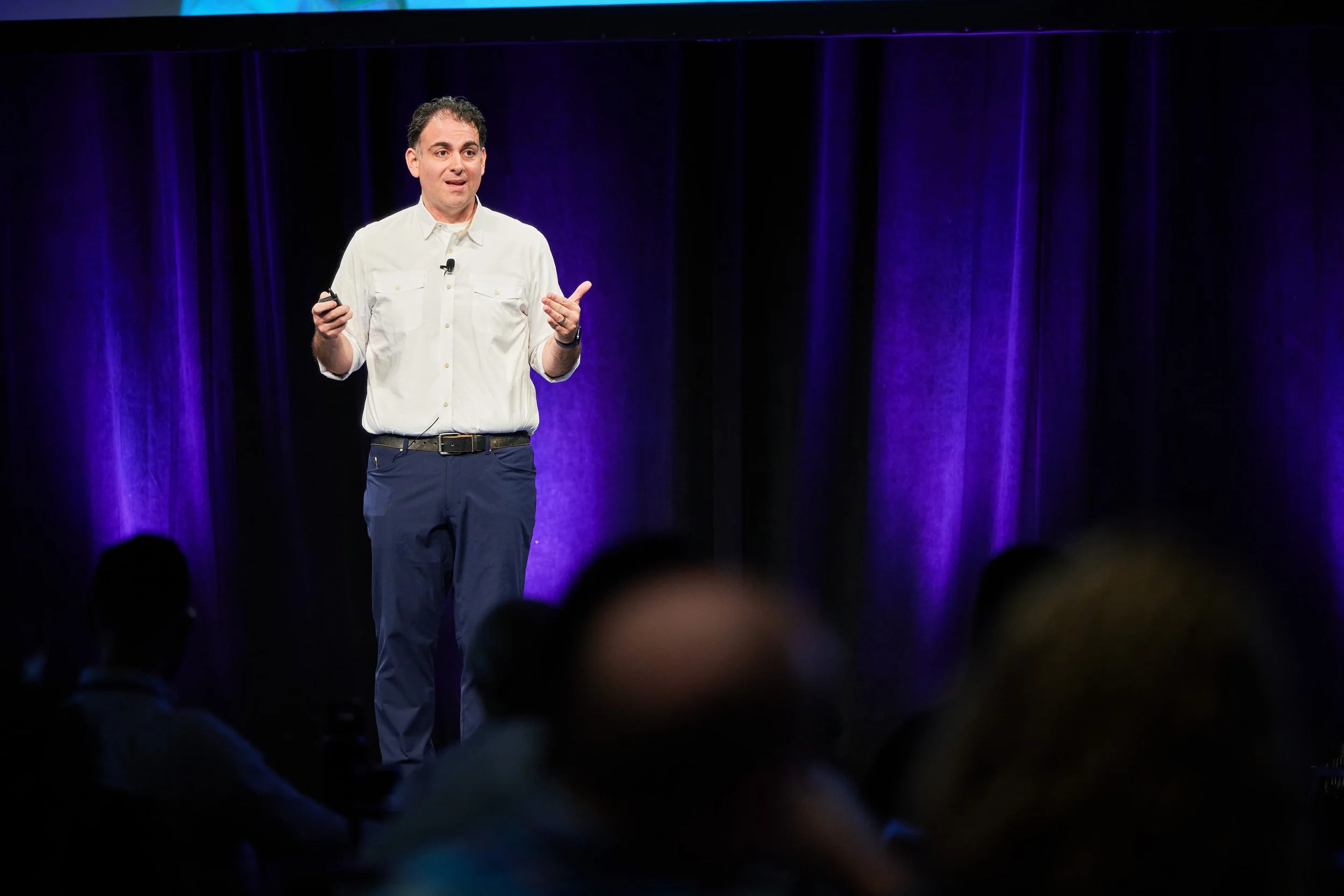
Great educators are leaving. Mark helps you build the culture that makes them stay.
For K-12 and higher education teams that care about their students and want to live a healthy culture at work.
Trusted by k-12 and higher education organizations.
“Working with Mark was absolutely fantastic. Mark really looked to address the needs of our attendees. We are super grateful for Mark!”
— Raj White, National Association of College Auxiliary Services (NACAS)
About Mark
-
A former communication executive who led award-winning teams and strategy for global brands like Microsoft, Adobe, and Amazon, and who has naturally lost and kept off 150 pounds over 15 years, Mark Mohammadpour combines Fortune 50 leadership experience with certified health coaching expertise.
-
His Keynote Conversations blend full attendee engagement, actionable insights, and current research.
Today, his most requested topics, Leading with Empathy, The Buoyant Leader, and Lead a Culture of Well-being, are built around one belief: healthy employees are your greatest competitive advantage.
Mark has worked with K-12 districts, university leadership teams, and education associations, and he understands that educators have heard many promises in many professional development sessions.
-
He builds his programs with one assumption built in: your staff will be skeptical until the first five minutes prove otherwise. His frameworks are grounded in the same research that drives outcomes in clinical and corporate settings, and translated into language that resonates with classroom teachers, department chairs, and district administrators alike. He also understands that in education, “retention” isn’t just an HR metric: it’s the difference between a thriving school and a community in crisis.
Who We Help
-
The Goal: Listen, learn, and act with intention to stabilize employee well-being and retention.
The Result: Improved student outcomes and a culture where educators and staff want to stay.
-
The Goal: Navigate the "Enrollment Cliff" and protect faculty mental health.
The Result: High-performing administrative teams and reduced "academic burnout."
-
The Goal: Providing Professional Development that actually sticks for your members.
The Result: Increased member loyalty and high-impact conference programming.
What we address
-
Staff burnout that shows up in turnover, missed deadlines, and quiet resignation.
-
Leadership teams who don't have the time or structure to take care of themselves, let alone their people.
-
A generation of employees who see campus jobs as transactional, not vocational.
The Chase Model™: Create a Culture operating system
We ensure your cultural shift is permanent. By integrating the CHASE Model into your daily workflow, you create a sustainable ‘Culture OS’ that drives retention and performance. This is where your investment pays off—with a team that is not just healthier, but significantly more productive and connected to your mission.
-
We begin by looking past the symptoms of burnout and turnover to identify the underlying friction. Using data-driven insights and team pulse surveys, we pinpoint the specific communication gaps and well-being hurdles that are currently preventing your business from "soaring." We don't just address the "what"; we uncover the "why."
Using The CHASE Model™, Mark shows how managers and directors can rebuild their leadership approach around capacity rather than compliance, and why the back-office culture is the product your guests experience at the front desk.
Through research, real stories, and interactive moments, your leaders leave with a practical playbook for building a team that shows up consistently and stays.
-
In every high-performing organization, your employees are the heroes of the story. We focus on the human beings behind the titles; the people driving your innovation and serving your clients. By shifting the perspective to see every team member as a vital contributor to a healthy culture, we foster the "Buoyant Leadership" mindset required to navigate high-pressure corporate environments.
-
This is where the Keynote Conversation or Offsite Experience takes center stage. We move beyond “passive listening” into “active participation.” Through live simulations, real-time polling, and empathy-based training, your team practices the exact communication and well-being skills they need to implement the very next day.
-
Change only sticks when it’s integrated into the workflow. We co-create a written Team Charter and deploy the Team Culture OS™—a customized leadership operating system designed to fit into your existing daily routines. This isn’t a one-and-done event; it’s the blueprint for how your team will communicate, collaborate, and support one another moving forward.
-
What gets measured gets managed. We close the loop with a 30/60/90-day accountability plan and post-event "Health Checks." By tracking attendee engagement metrics and following up on specific culture-growth milestones, we ensure your investment yields a tangible return—both in team morale and the bottom-line performance of your "wealthy team."
“Mark’s energy and enthusiasm are refreshing and motivating! I highly recommend Mark’s keynote speaking opportunities and his workshops that help find the work-life balance we are all searching for to keep our sanity.”
— Sam Briggs, APR, Director of Communication, Widefield School District 3, Colorado
keynote conversation topics
The Buoyant Leader: Healthy Under Pressure
Why the Most Grounded Education Leaders Soar. Education leaders are currently managing a student mental health crisis, teacher burnout, and their own quiet exhaustion simultaneously.
-
This keynote reframes resilience as a deliberate daily practice rather than a static trait. By blending neuroscience and humor, Mark provides a framework for staying grounded while sharing the emotional weight of leadership.
-
77% of workers experience work-related stress, and a leader’s emotional state is contagious to the entire building.
-
Administrators will build resilience as a daily leadership practice rather than relying on experience alone.
Leaders will learn to see budget and staffing pressures as signals to lead with more clarity.
Grounded "calm" will be utilized as a specific instructional leadership advantage.
Principals will understand how their own steadiness creates the safety teachers need to stay engaged.
Leaders will leave with practical moves they can use before the next bell rings.
Lead a Healthy Culture of Well-Being
How the Best Schools Make Educator Well-Being the Way They Work. The highest-achieving schools don’t just invest in curriculum; they invest in the conditions that keep teachers present and energized.
-
This session shifts the focus from “self-care” initiatives to leadership redesign. Mark demonstrates how everyday choices, from how a meeting starts to how feedback is delivered, either protect or erode a team’s collective well-being.
-
With 52% of employees feeling unsupported by their employer, the gap in educator support has become a retention crisis.
-
Leaders will reimagine well-being as a core outcome strategy.
Administrators will recognize how their daily decisions compound into the culture that retains or loses talent.
Psychological safety and educator energy will be treated as measurable, essential outcomes.
The CHASE Model™ will be adapted to improve peer collaboration and professional recognition.
Leaders will leave with a simple, repeatable framework to track and boost staff well-being starting this week.
Leading with Empathy
Trust is the New Productivity in Education. Education is the most empathy-intensive profession in the world; the schools that thrive show that empathy flows to the staff, not just the students.
-
This session moves empathy from a “nice-to-do” philosophy to a strategic leadership skill. Mark shows how cognitive empathy, understanding what an educator is carrying, makes administrators more effective coaches and advocates.
-
Empathetic leadership is one of the highest-leverage retention strategies, as staff with empathetic leaders are 5x more likely to stay.
-
Leaders will understand why cognitive empathy is the behavior most linked to teacher retention.
Attendees will use perspective-taking to bridge gaps between departments and experience levels.
Trust will be redefined as a tool for student outcomes that radiates into every classroom.
Empathy skills will be applied to high-stakes moments such as parent escalations and staff conflicts.
Administrators will leave with practical tools to reduce friction across the school community.
REWORK: The Future-Ready Leader
The Playbook for Healthy, High-Trust Leadership in Education. More than half of educators are considering leaving the profession earlier than planned. Principals and department heads often have no playbook for reversing this trend. This keynote is that playbook.
-
In this session, education leaders move from a “compliance” mindset to a “capacity” mindset. Instead of trying to squeeze more out of an exhausted staff, leaders learn to create the conditions where great educators want to stay. Mark introduces The CHASE Model™ to show why educator well-being is not a budget line item, but a primary student outcome.
-
1 in 4 teachers are likely to leave their current school within the year. Making this a leadership conversation is a critical step to address.
-
Leaders will evaluate effectiveness through educator energy and clarity rather than just observation rubrics.
Teams will apply The CHASE Model™ to onboarding and instructional coaching.
Attendees will treat school culture as a strategic operating system that drives student success.
Administrators will identify and protect their team’s capacity as a high-leverage success strategy.
The community will leave with a shared framework to build high-trust environments.
work in sunlight
Rekindling Belonging and Purpose in Education. 55% of educators are considering leaving early. This keynote helps leaders create the conditions for the belief and purpose that brought them into schools to come back to life.
-
Mark demonstrates that belonging isn’t something you can mandate; it is something leaders build through daily choices. This high-energy session helps teams reconnect to their mission and to each other.
-
Strong belonging makes employees 50% less likely to leave, serving as the critical antidote to the current retention crisis.
-
Purpose will be rediscovered as a daily leadership practice, not something staff must sustain alone.
Belonging will be established as the foundation for teacher retention and student achievement.
Professional motivation will be reimagined as a collective effort rather than individual passion.
Leaders will implement Daily Sunlight Habits to keep energy alive throughout the school year.
Teams will leave with a shared Sunlight Map™—an actionable plan for sustaining belonging in their district.
upgrade to the Three-point impact
Most keynotes are forgotten by Monday. The Three-Point Impact makes sure yours isn’t. A keynote + facilitated team session + follow-up coaching, so your people remember, apply, and repeat what they learned.
“Mark has totally revamped the way I think about health.”
— Christy McGee, APR, Director of Communications, Fountain-Fort Carson School District 8, Colorado
Let’s talk about your team.
Email Mark at mark@chasingthesunpdx.com and we’ll respond within 1 business day.
Frequently asked questions
How can school districts improve teacher retention and reduce burnout?
1
Improving teacher retention requires shifting from individual “self-care” tips to systemic resilience. Mark Mohammadpour helps K-12 districts move beyond “one-and-done” PD days and fosters administrative alignment. By prioritizing educator efficacy and psychological safety, districts can stabilize their staffing and improve long-term student outcomes.
What is the link between educator well-being and student success?
2
When educators experience Compassion Fatigue or “Quiet Resignation,” the industry is impacted. Mark Mohammadpour’s framework emphasizes that a healthy school culture is the foundation for student success. By equipping staff with leadership tools to manage high-pressure environments, schools create a more stable, effective learning environment.
How do you make Professional Development (PD) "stick" for cynical staff?
3
Mark Mohammadpour’s 3-Point Impact Framework extends conversations from a one-time session to lasting change. By involving staff in the co-creation of communication norms and leadership boundaries, the training becomes an integrated part of the daily school cadence.
Why should educational associations include leadership resilience in their conference programming?
4
Educational associations add value to their members by addressing industry-wide crises. By featuring a keynote speaker focused on Strategic Leadership and Well-being, associations offer “sticky” content that addresses the root causes of turnover. This positions the association as a vital partner in its members’ professional survival and long-term career growth.